Understanding the basics of vehicle maintenance doesn't require technical training. What it does require is a general sense of what your car needs, when it needs it, and what happens when those needs are ignored for too long. This article covers the key areas — some of which you can monitor yourself, others which require a professional visit.
Why Regular Maintenance Matters
A modern vehicle contains hundreds of components working in close coordination. Most of them wear gradually rather than failing suddenly, which means problems often develop slowly over time. Regular maintenance exists to catch these gradual changes before they become significant — and to replace consumable components at a stage when doing so is straightforward rather than costly.
The alternative — running a vehicle until something stops working — typically results in more complex repairs that could have been avoided. It can also affect safety in the interim, particularly where braking or steering components are concerned.
Worth noting: Manufacturer-specified service intervals exist for a reason. They're determined through engineering data, not conservative guesswork. Extending intervals significantly beyond the recommendation tends to increase the likelihood of premature component wear.
Engine Oil — The Most Frequently Overlooked Item
Engine oil performs several functions: it lubricates moving parts to reduce friction, helps carry heat away from critical areas, and suspends fine particles and combustion byproducts that would otherwise cause wear. Over time, the base oil degrades and the additive package within it depletes.
Oil change intervals vary considerably depending on the engine type, the oil specification, and how the vehicle is used. A turbocharged engine running short journeys in city traffic will consume oil quality faster than a naturally aspirated engine used mainly on longer runs. The figure in your handbook is a starting point; your actual usage pattern might mean a slightly shorter interval is appropriate.
Checking Oil Level Yourself
Most vehicles have a dipstick that allows you to check oil level manually. The correct procedure is to check when the engine is cold (or at least 10 minutes after switching off a warm engine), on level ground, with the dipstick fully seated before removing it for a reading. The oil level should sit between the minimum and maximum marks. If it's consistently below the midpoint, mention this at your next service visit.
Tyre Condition and Pressure
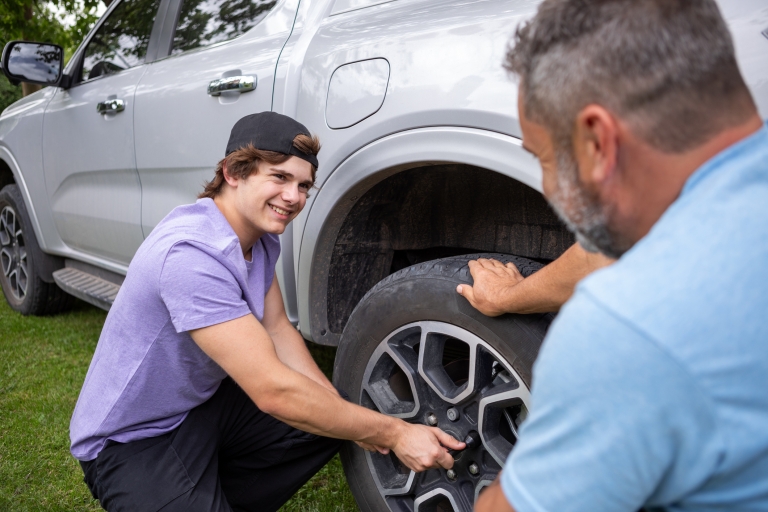
Tyres are the only point of contact between the vehicle and the road. Their condition affects braking distance, handling response, and fuel efficiency — sometimes more significantly than people expect.
Tread Depth
The legal minimum tread depth in most European countries is 1.6mm across the central three-quarters of the tyre. However, testing consistently shows that braking performance on wet roads deteriorates noticeably as tread depth falls below 3mm. Many tyre manufacturers and safety organisations recommend replacement before the legal minimum is reached for this reason.
You can measure tread depth with an inexpensive gauge, or use the tread wear indicators moulded into the grooves of most tyres. When the surface of the tyre is level with these indicators, the tyre is at the legal minimum.
Tyre Pressure
Under-inflated tyres deform more under load, which increases rolling resistance and fuel consumption, generates more heat, and accelerates wear on the outer edges of the tread. Over-inflated tyres make less contact with the road surface, which can reduce grip. The correct pressure for your vehicle is listed in the handbook and usually also on a sticker inside the driver's door frame — not on the tyre sidewall, which shows the maximum pressure the tyre can handle.
Tyre pressure changes with temperature: cold weather reduces it, warm weather increases it. Checking pressures monthly, and always when cold, is a straightforward habit that pays consistent dividends.
Brake System
Brake pads are consumable items. They wear each time you brake, and the rate of wear depends on braking frequency, load, and pad material. Front pads typically wear faster than rear pads on most front-wheel-drive vehicles due to weight distribution.
Signs that brake pads may be wearing thin include a squealing noise when braking (a deliberate wear indicator built into many pad designs), a grinding sound when braking (indicating the pad material has worn away), or a longer stopping distance. Any of these symptoms warrants a brake inspection sooner rather than later.
Brake fluid, as mentioned in our services description, absorbs moisture over time. Most manufacturers recommend replacement every two years, regardless of mileage. Checking fluid level in the reservoir under the bonnet is straightforward — the reservoir is usually clearly labelled, and the level should sit between the min and max marks.
Coolant and Operating Temperature
Coolant serves two purposes: it prevents the engine from overheating in warm conditions and from freezing in cold ones. It also contains corrosion inhibitors that protect the cooling system from internal rust and scale buildup. These inhibitors deplete over time, which is why coolant eventually needs replacing even if the level hasn't dropped.
The coolant level can be checked when the engine is cold at the coolant reservoir, which is typically a semi-transparent plastic tank near the radiator. Do not remove the radiator cap on a warm engine — the system is pressurised, and doing so can cause scalding fluid to escape.
If you notice the temperature gauge rising into the red zone, or a warning light indicating overheating, stop the vehicle as soon as it's safe to do so. Continuing to drive an overheating engine can cause serious and expensive damage.
Battery Health
A vehicle battery typically lasts three to five years, though this varies with climate, how frequently the vehicle is used, and whether the battery is regularly fully charged (as happens on longer drives) or repeatedly discharged and partially charged (common in vehicles used only for short journeys).
Early signs of a weakening battery include slower engine cranking when starting, particularly in cold weather, or electrical features behaving inconsistently. A battery test — which most workshops can carry out in a few minutes — measures remaining capacity under load and gives a clearer picture than a simple voltage reading.
Air Filter
The engine air filter prevents dust, debris, and particles from entering the intake system. As it accumulates material, airflow restriction increases, which can affect engine performance and fuel consumption marginally. Replacement is typically straightforward and relatively inexpensive. Most vehicles list an air filter interval in the service schedule — around 20,000 to 30,000 km in many cases, though dusty driving conditions accelerate clogging.
Lights and Visibility
Checking your vehicle's lights periodically is simple and takes a few minutes. Walk around the car with the headlights and indicators on, then check the reversing lights and brake lights with assistance from someone standing behind the vehicle. A failed bulb affects visibility and is a legal requirement to maintain.
Wiper blades are often neglected until they smear rather than clear. Replacement is straightforward and the improvement in wet-weather visibility can be noticeable. If your wipers are leaving streaks or making dragging sounds, they're probably past their useful life.
Following a Service Schedule
The most consistent approach to vehicle maintenance is to follow the manufacturer's service schedule, which sets out which items need attention at which intervals. Most schedules are mileage-based, with some items also having a time-based interval (e.g., brake fluid every two years regardless of mileage).
If you've acquired a vehicle whose service history is unclear, a catch-up service from a qualified workshop can establish a baseline — checking and replacing consumables as needed, and identifying anything that requires attention.
A note on mileage-based vs. time-based intervals: If you drive very little, time-based intervals may be more relevant for some items (oil, brake fluid) than mileage. A vehicle that's driven 8,000 km over two years still needs its brake fluid replacing on the two-year cycle.
Knowing When to Seek Professional Input
Some checks — oil level, tyre pressure, lights, coolant level — are genuinely straightforward for most drivers. Others are better left to someone with the right tools and training. Dashboard warning lights fall into this category: while some (like the low fuel light) are self-explanatory, others — particularly engine management or stability control lights — require diagnostic equipment to interpret correctly.
If something changes in how your vehicle drives, sounds, or responds, it's worth noting and mentioning at the next service visit — or sooner if it's a sudden or significant change. A description of when the symptom occurs, what you can hear or feel, and roughly when it started helps a technician narrow down the likely causes considerably before they look at the vehicle.
Regular maintenance, carried out consistently, is one of the more cost-effective things you can do to preserve a vehicle's reliability and longevity over time.